When Can a Dog Use Stairs After TPLO Surgery?

Returning to stairs after TPLO does not follow a fixed date for every dog. The procedure changes tibial geometry through an osteotomy that is stabilized with a plate and screws while the bone heals. A dog may bear weight early and seem eager to move, but that does not mean the surgical site can already withstand rapid movements, turns, jumps, or an uncontrolled descent.
Going up and going down place different demands on the body. Climbing requires the dog to generate force with the hind limbs. Descending requires controlled weight-bearing while the joints flex and balance is maintained, which may be more difficult. Slippery, narrow, or high steps increase the risk. A dog that uses the operated limb on level ground may still compensate, lose stability, or slip on stairs.
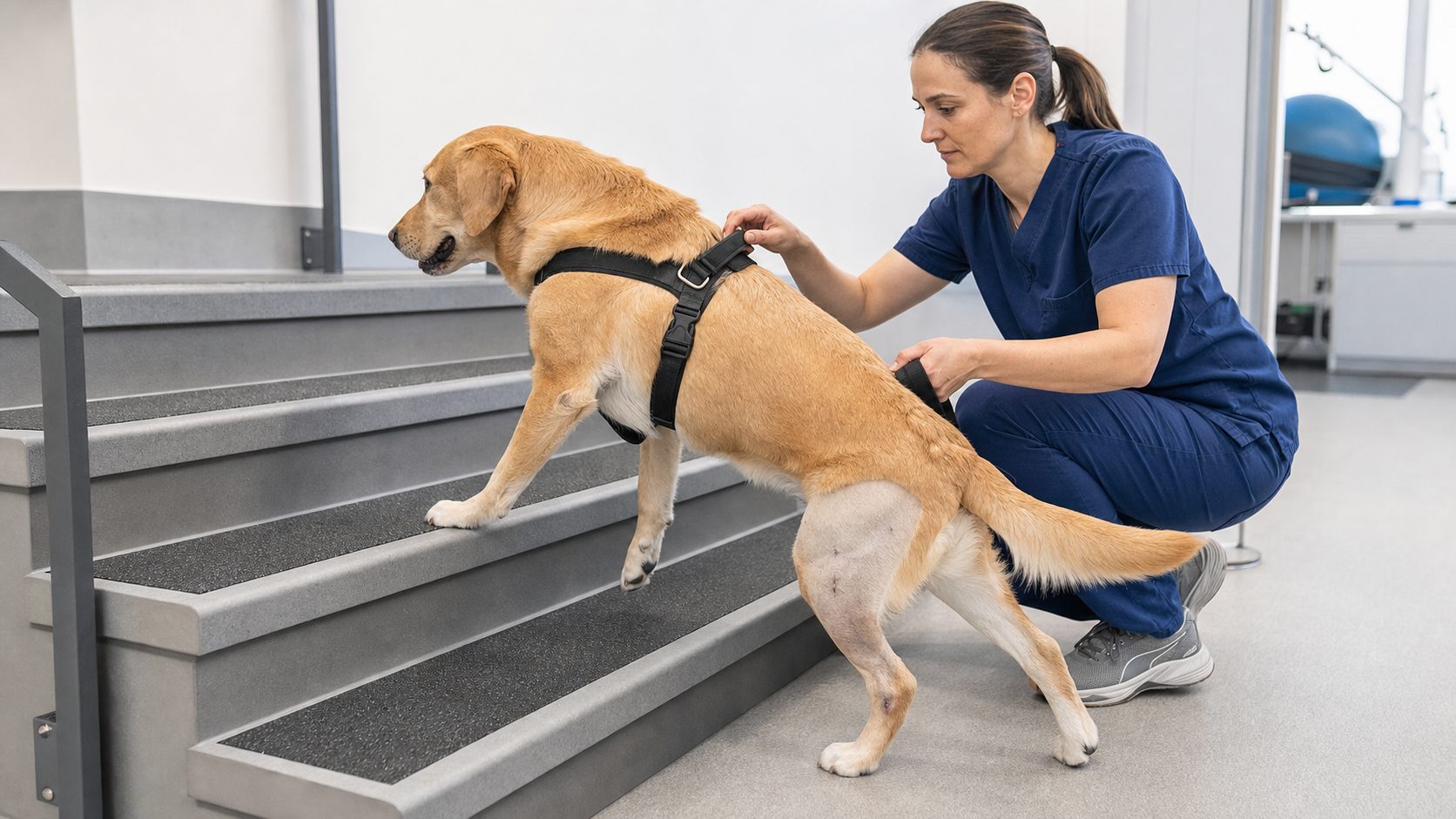
During the first few weeks, unrestricted access to stairs is usually blocked. When a staircase is unavoidable for getting outside, the surgeon may allow a short, controlled passage with a leash, harness, and support, depending on the patient. This is different from allowing the dog to climb alone several times a day. Carrying must also be safe for both the owner and the dog; larger dogs may require a temporary ramp or a change in routine.
The decision takes into account follow-up radiographs, pain, swelling, weight-bearing, muscle strength, and movement quality. Incomplete bone healing, infection, implant problems, or increasing lameness delay progression. Even with favorable radiographs, a dog that loses balance or places little weight on the limb is not ready to use stairs unsupervised. Clinical assessment and imaging complement each other.
The TPLO procedure addresses instability associated with a cranial cruciate ligament rupture, but it does not immediately eliminate inflammation, osteoarthritis, or muscle loss. Many dogs already have thigh muscle atrophy by the time of surgery. Rebuilding strength and neuromuscular control reduces stress on the knee and the opposite limb. Veterinary rehabilitation organizes this progression with level-ground exercises before changes in elevation are introduced.
Once clearance is given, training starts with only a few steps, a slow pace, a short leash, and a nonslip surface. The dog should not jump over the final steps or run toward the destination. Barriers remain useful outside supervised sessions. Repetitions are increased gradually and reduced if pain, swelling, poorer weight-bearing, or disproportionate fatigue appears.
Secure rugs and adequate lighting make the environment safer. Slippery socks, loose runners, and steep ramps can increase the risk. Stair exercises should not be improvised in an attempt to “build strength faster” before clearance, because excessive loading does not accelerate bone healing. Medication also should not be used simply to make a dog tolerate an activity for which the tissues are not ready.
Contact the veterinary team if the dog slips, falls, stops bearing weight, develops a painful clicking sound, shows increased swelling or discharge, or worsens suddenly. Functional return is gradual over several weeks for many patients, but the timeline must be individualized. The safe time is when bone healing, the knee, muscle strength, and coordination have been reassessed and stair use has been expressly added to the rehabilitation plan.
Bibliographic reference: Monk, M. L.; Preston, C. A.; McGowan, C. M. Effects of early intensive postoperative physiotherapy on limb function after tibial plateau leveling osteotomy in dogs with deficiency of the cranial cruciate ligament. Veterinary Record, v. 159, n. 7, p. 229-234, 2006.
Bibliographic reference: Alvarez, L. X.; Repac, J. A.; Kirkby Shaw, K.; Compton, N. Systematic review of postoperative rehabilitation interventions after cranial cruciate ligament surgery in dogs. Veterinary Surgery, v. 51, n. 2, p. 233-243, 2022. doi: 10.1111/vsu.13755.