Can Lumbosacral Disease Cause Incontinence in Dogs?

Lumbosacral disease in dogs can affect the nerves that exit at the end of the spine, a region known as the cauda equina. These nerves contribute to movement and sensation in the hind limbs, tail, and perineum, as well as part of urinary and fecal control. For this reason, incontinence can occur in severe disease in this area, but it is not the most common sign and should not automatically be attributed to the spine.
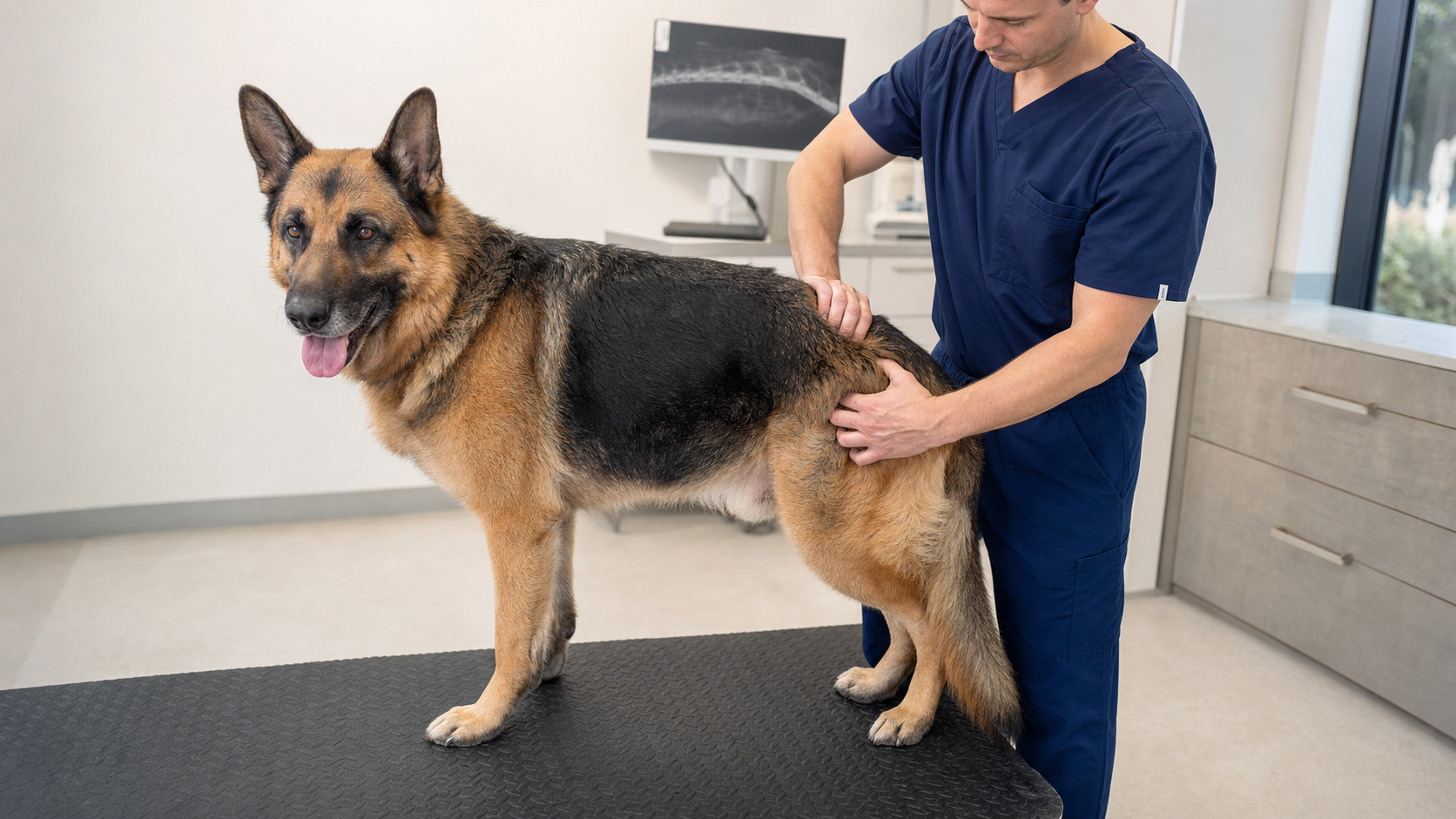
In degenerative lumbosacral stenosis, the disc, ligaments, joints, and bony structures reduce the space available for the nerve roots. Large-breed dogs, especially active adults, may show pain when rising, difficulty jumping, reluctance to climb stairs, and reduced performance. Some develop weakness, drag their nails, or lose muscle mass. Cauda equina syndrome describes this combination of pain and neurological deficits.
Urinary changes are concerning when a dog does not sense that the bladder is full, cannot empty it, or leaks urine without assuming a posture to urinate. Loss of anal tone, altered tail movement, and reduced sensation in the perineum may also occur. However, these signs usually indicate more advanced neurological impairment and require prompt assessment.
Most cases of urinary incontinence in dogs have other explanations. Urethral sphincter mechanism incompetence, urinary tract infection, stones, prostatic disease, hormonal disorders, malformations, and increased urine production are common diagnoses. Severe pain may also prevent a dog from getting outside in time, causing accidents that appear to be incontinence. Distinguishing involuntary leakage, urgency, and overflow retention completely changes treatment.
The consultation includes a detailed history of the volume, frequency, posture, and timing of the episodes, along with a neurological examination and bladder palpation. Urinalysis, culture, blood tests, and ultrasonography assess the urinary tract. When signs are consistent with lumbosacral disease, radiographs show general bony changes, while computed tomography and magnetic resonance imaging are more useful for evaluating compression, the disc, and nerve roots.
A degenerative finding on imaging does not prove that the spine caused the incontinence. Many adult dogs have lumbosacral changes without urinary leakage, and urinary disorders may coexist. Correlating the examination, bladder pattern, and imaging helps avoid surgery or medication directed at the wrong cause. In some cases, urodynamic testing or a specialist assessment completes the investigation.
Treatment of lumbosacral disease may involve activity restriction, weight management, prescribed pain relief, rehabilitation, or surgical decompression, depending on the pain, neurological deficit, and imaging findings. Incontinence requires its own approach and may call for bladder management to prevent overdistension and infection. The bladder should not be expressed and medication should not be adjusted without training and follow-up.
Seek urgent care if a dog suddenly loses urinary control, cannot urinate, develops an enlarged bladder, progressive weakness, severe pain, or loss of sensation. When accidents develop gradually, investigation is still necessary. Separating lumbosacral disease from more common urinary causes allows the real problem to be treated while protecting the kidneys, bladder, nerves, and quality of life.
Bibliographic reference: Worth, A. J.; Meij, B. P.; Jeffery, N. D. Canine Degenerative Lumbosacral Stenosis: Prevalence, Impact and Management Strategies. Veterinary Medicine: Research and Reports, v. 10, p. 169-183, 2019. doi: 10.2147/VMRR.S180448.
Bibliographic reference: Byron, J. K.; Taylor, J. A.; Phillips, G. S.; et al. ACVIM consensus statement on diagnosis and management of urinary incontinence in dogs. Journal of Veterinary Internal Medicine, v. 38, 2024.